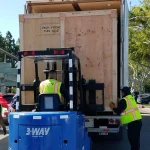
A semiconductor supply chain manager once gave us one of our favorite compliments: “The load was secured better than I have seen in 25 years of loading trucks.”
We’ll happily take it, but the interesting part is everything that had to happen before that truck ever moved.
Semiconductor equipment has a habit of exposing weak handoffs. The warehouse crew unloads it. Somebody else prepares it for transport. A driver takes custody. A rigging crew meets it at the other end. Add enough companies to the chain and pretty soon you’ve got four versions of where one company’s responsibility stopped, and the next one started.
Nobody enjoys sorting through those versions when the freight in question costs seven figures.
It’s also one reason our semiconductor work grew beyond transportation. Customers kept asking us to handle more of the move, so warehousing led into trucking, rigging, machinery moving, and crating. Putting those pieces together gave us tighter control over the awkward part of high-value logistics: what happens between them.
That’s really the job of chain of custody logistics. A 3PL needs a clean, continuous record of who controlled the freight, where it went, what condition it was in, and exactly what happened at every transfer.
What Is Chain of Custody in Logistics?
Chain of custody in logistics is the documented record of who controlled a shipment at every stage, when responsibility changed hands, and what condition the freight was in at each transfer.
For high-value equipment, that record should answer a few basic questions:
- Who released it?
- Who loaded and transported it?
- Who received it?
- When did each handoff happen?
- What condition was it in each time custody changed?
Those answers need proof behind them, which is where timestamped photos, signatures, condition reports, shock readings, and transfer records come in. Together, they create a custody trail you can follow later without relying on somebody’s memory of what happened on the dock.
NIST uses the same principle for evidence, documenting who handled it and when custody changed. In freight, tracking adds location to that record, while the custody trail ties each movement to a responsible party and a documented condition.
Where Does Chain of Custody Usually Go Wrong?
Chain of custody usually goes wrong at the handoffs, especially when a shipment moves between companies, facilities, or crews and nobody has a clean record of who took control next.
With high-value freight, those trouble spots start early. Verisk CargoNet reported $304.6 million in cargo theft losses in Q2 2026, and hacked email accounts helped thieves show up with legitimate-looking pickup details.
Once the freight is moving, the first leg deserves just as much attention. Overhaul says 37% of U.S. cargo theft happens within the first 200 miles out of Southern California.
Then there’s final delivery, where the problem is often less dramatic and just as costly. If a crew reaches an electron microscope without the right tools or instructions, nobody stole the shipment, but your install date can still disappear.
How Do 3PLs Guarantee Chain of Custody for High-Value Freight?
3PLs protect chain of custody by keeping control of the freight with as few companies as possible, documenting every transfer, and making one team accountable from pickup through final placement. Nobody can promise that nothing will ever go wrong, but you can remove a lot of the gray area where responsibility usually gets lost.
That’s what we did for one semiconductor customer. The tools moved through our Southern California facility, traveled on our air-ride trailers, waited in our Texas warehouse when the fab schedule slipped, then went to our cleanroom-trained riggers for uncrating and placement.
The customer didn’t have to piece together three vendors’ timelines if something looked wrong. The same operation stayed responsible for the equipment across the move, which gave them one custody trail and one company on the hook for answering questions.
Who’s Liable When Chain of Custody Breaks?
Liability usually depends on who had custody when the loss or damage occurred, what that company was responsible for, and what your contract says. A clean custody trail gives you the evidence to sort that out without spending the next week collecting everybody’s version of events.
For interstate trucking, the Carmack Amendment generally makes carriers liable for actual loss or damage to the freight, subject to agreed limits. Where it gets painful is everything around the damaged equipment. A claim may cover the tool while doing very little for the fab time you lose waiting for a replacement.
Brokers have exposure too. In Montgomery v. Caribe Transport II, the Supreme Court allowed a negligent-selection claim against a broker to proceed. Schneider later cut its approved brokerage network from 60,000 carriers to 14,000 as vetting and cargo risk got harder to shrug off.
What to Ask Before You Hand Over the Keys
Before you hand a 3PL the keys to a multimillion-dollar tool, ask them to walk you through the move as if something goes wrong at every handoff. You’re trying to find out who touches the equipment, how each transfer gets documented, and whether there’s a real operating process behind the sales deck.
A few questions usually tell you pretty quickly what you’re dealing with:
- Who Actually Touches the Freight? Ask for the full custody map, including subcontractors, warehouse crews, drivers, riggers, and anyone else who gets physical control of the equipment. Every extra company adds another handoff you’ll have to untangle later.
- How Do You Verify the Driver at Pickup? This one deserves more attention than it used to. Overhaul reported a 31% increase in deceptive pickups in Q1 2026, so “they had the pickup number” doesn’t cut it anymore. Ask whether they photograph the driver’s license, tractor and trailer plates, seal, and loaded trailer before the truck leaves.
- What Gets Documented at Every Handoff? You want more than a signature on a delivery receipt. Ask for timestamped photos, condition reports, seal records, shock readings, and whatever else they use to show what the equipment looked like when custody changed.
- What Does Your Insurance Actually Cover? Don’t settle for “we’re fully insured.” Ask what the cargo limits are, what exclusions apply, and how the policy treats high-value machinery, rigging, storage, and installation work. Heavy-equipment insurance can look very different once you read the fine print.
- Who Owns the Problem at 5 a.m.? Somebody should be able to tell you exactly who gets the call if a truck misses a check-in, a seal looks wrong, or the fab changes the install window overnight. “We’ll escalate it internally” is not a particularly comforting answer when your equipment is already moving.
- Can You Show Me a Real Custody File? Ask to see the paperwork from a recent high-value move, with customer details redacted if necessary. A 3PL that talks a good game should be able to show you how the process actually looks after the truck leaves the dock.
Our semiconductor logistics vetting checklist goes deeper on the rest. Run it on us too. We’d rather answer the hard questions before the move than explain the easy ones after something goes wrong.
How Three Way Keeps Custody in One Set of Hands
For us, keeping the chain of custody tight starts with giving the equipment fewer companies to visit.
Three Way Logistics can handle the crating, warehousing, transportation, rigging, and installation support as one operation. We build crates in-house, run an asset-based fleet, and operate warehouses that support our rigging teams, so a semiconductor tool can move from storage to trailer to fab floor without the customer having to manage a relay race of vendors.
We grew into that model because semiconductor customers kept asking us to take on more of the move. Three Way started in San Francisco in 1954, followed the high-tech industry to Sunnyvale in the 1970s, and now serves customers from 18 U.S. locations with transportation across all 48 contiguous states.
The name, funny enough, comes from the three ways you could drive out of SFO. Seventy-plus years later, much of our job is saving customers from coordinating three different companies.
If there’s a high-value move on your calendar you’ve been dreading, send it our way or call 408-748-3929. We’ll show you who touches the equipment from the first crate through final placement.