The truck is the part of the move everybody plans for. It has a PO, a delivery window, and a slot on the dock schedule, and when it backs in on time, the project channel gets a confirmation image and a thumbs-up.
Then the straps come off. The 40,000-pound tool that looked great on the trailer now has to fit through a door that’s always seems a bit narrower than the drawing. We’ve watched that part go both ways for 70 years.
The stretch between the tailgate and the anchor bolts is what industrial rigging services cover, and most people still buy it like a line item under freight. With data center construction running 57% ahead of last year, that habit is about to get tested on a lot of equipment that can’t be reordered in a hurry.
So, yes, this writeup is about the last 200 feet. Written for the person whose name is on the install date.
What Do Industrial Rigging Services Include?
Industrial rigging services cover everything after the straps come off, and it’s a longer list than it sounds. A rigging crew plans the lift, breaks the machine down if it won’t fit, gets it across your floor, sets it level, anchors it, and hauls the old one out.
To put it simply, trucking delivers to your address; rigging delivers to the spot where the machine spends the next decade.
You’ll also see it quoted as machine rigging services, machinery moving, or specialty rigging services, depending on what the last salesperson liked. If you run a fab or a data hall, you’re buying the specialty kind, where the crew gowns up for a cleanroom or works inside a live hall.
The label matters less than what’s on the truck.
What Equipment Should an Industrial Rigging Crew Bring?
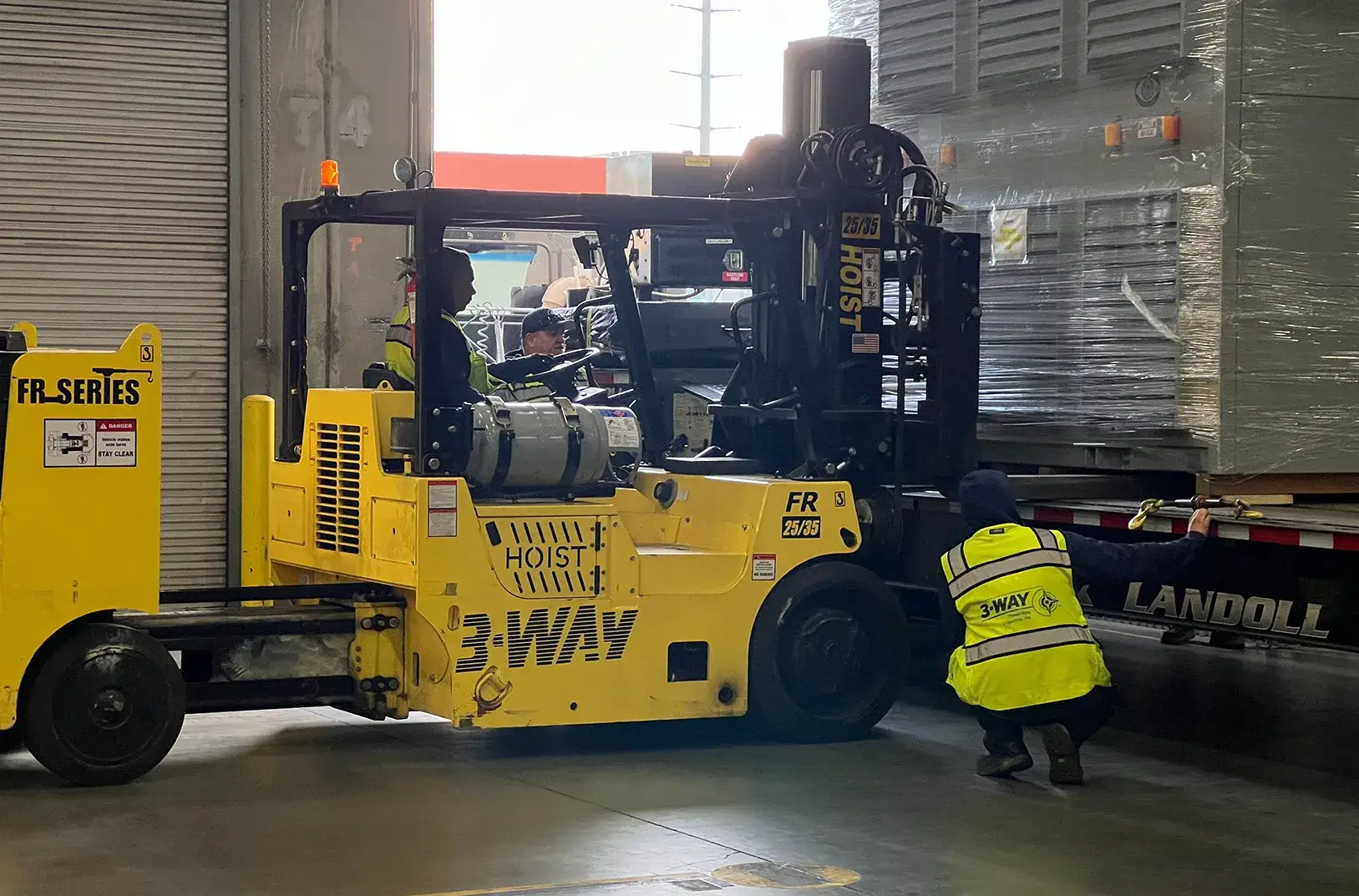
A crew that does this every week rolls in with gantries, hydraulic jacks, machine skates, air bearings for floors that can’t take a point load, and load cells to weigh the machine instead of trusting the sticker. The exact mix depends on your machine and your building, so a good rigger asks about both before quoting.
A building without an overhead crane usually means a gantry shows up with the crew, and a raised floor in a data hall gets plated or shored before anything rolls across it. Get a list of what’s coming on the truck and why each piece made the cut.
If the plan is a forklift and two guys, the carrier would’ve offered you that, so ask what the rigging line pays for.
Why Can’t the Truck Bring It Inside?
Because trucking and rigging are two different jobs, and trucking ends at your dock. The driver won’t know the machine’s center of gravity or how much of a bump it can take, and he shouldn’t have to. Our own drivers would tell you the same.
A good rigging crew walks the route from your dock to the pad weeks before move day, while fixes are still cheap. The walk catches a doorway that’s narrower than the drawing or a trench drain in the path.
Floors are the sneaky one. A slab rated for a parked machine might not hold up when that same machine rolls across on skates, because skates concentrate the weight on a few small rollers.
The dock handoff is where people get hurt, too. Safety researchers at CPWR studied 15 years of construction crane injuries. Getting hit by the load was the No. 2 cause, and 32% of those injuries happened during loading and unloading.
What Should a Lift Plan Tell You?
A lift plan spells out how the rigger will lift your machine and move it into place. It also tells you whether they understand your job.
First, ask what type of lift your move counts as. The industry standard, ASME P30.1, sorts lifts into two types: standard and critical. Critical is for higher-risk lifts, and high-value equipment often lands there. A good rigger answers right away. If you get a long pause, keep shopping.
Then read the plan closely. The weight should come from the OEM drawing or a load cell, and the center of gravity should be calculated. Your floor loading limits and cleanroom rules belong in there, too. If any of that is missing, the crew will be working it out on your floor, on your schedule.
Pay attention to when the plan shows up. If it arrives the morning of the lift, you picked a rigger on price alone. The fix costs nothing: ask every bidder for a plan before you sign, then see who suddenly needs another week.
How Do You Pick the Best Industrial and Machinery Rigging Company?
Ask better questions than the paperwork does. Most vetting forms for machinery riggers check two things: a rigging certification and an EMR. Neither one tells you whether this crew can set your machine without hurting anyone or anything.
Start with the certification. OSHA requires a qualified rigger on crane lifts, but it doesn’t issue a card for it. Each contractor decides who qualifies, so every rigger on your list says their crew does. Ask instead who makes that call, and what happens if the crew thinks the plan is wrong.
Next, ask the question most bidders would rather skip: Will the crew that walked your site be the crew that shows up on move day?
What If the Equipment Shows Up Before the Room Is Ready?
If your equipment shows up before the room is ready, it goes into storage until the room catches up. Ideally, that’s a climate-controlled warehouse near your site, run by your rigger. The machine waits somewhere dry and boring, and the crew that unloads it also sets it.
The wrong answer is leaving it on the trailer and hoping the drywall guys hurry up. Trailers rack up detention fast, and a steel box in the sun makes its own weather, including condensation inside a crate that was packed dry.
Delaying delivery usually isn’t an option, either. ENR reported in September that large power transformers have lead times up to 128 weeks. With a backlog like that, don’t expect a manufacturer to hold yours until the paint dries.
Before it leaves the factory, ask your rigger where it goes if the room isn’t ready. Our answer is a warehouse, because we’d rather hold it for six weeks than watch it bake in a lot for six days. If the rigger’s answer involves your parking lot, keep looking.
Who’s on the Hook When Rigging, Trucking, and Crating Are Three Different Vendors?
You are. Each vendor answers for its own piece, and the handoffs between them belong to whoever hired all three.
The skid shows up crushed on install morning, and the finger-pointing starts before anyone’s finished their coffee. Your carrier has photos of it leaving the dock in perfect shape. The rigger blames the crate, and the crating shop’s phone goes straight to voicemail.
Maybe they’re all telling the truth, since the damage happened somewhere between their jobs. You’re still the one walking a claim form into your VP’s office.
Subcontracted crews add another name to the blame game. AGC’s 2026 workforce survey found 87% of firms have open craft jobs, so a vendor that subs out rigging could send whoever’s free that week. You might meet them in your lobby on install day.
The way out is a single company that owns the whole move, from dock to anchor bolts. We run the trucking, crating, storage, and rigging ourselves, so when something goes sideways, there’s one number to call, and it’s ours.
Why Call Three Way for Industrial Rigging Services?
Because we’d rather own the whole move than hand it off halfway. We’ve been moving equipment since 1954, and our rigging division exists for the last 200 feet, where a good delivery can still become a bad install.
Our crews are based in Northern and Southern California, the Portland metro, Dallas-Fort Worth, and Central Texas, and they travel wherever the job is. Each base has a warehouse, so if your machine arrives early, it waits with us until the room catches up.
When the room’s ready, the people who unloaded your machine are the ones who level it on the pad. Plenty of our longest customers started with one job and some healthy skepticism, and the same crew at both ends tends to win them over.
If you’re skeptical too, send us the tool, the site, and the install window. We’ll walk it and tell you what the job needs, including the parts that never made the budget. Your equipment’s already on order, so decide who’s setting it before the schedule decides for you.