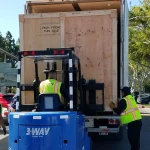

On your calendar there’s a circled date. An electron microscope comes off its pad at the old site next week, and by that Wednesday it’s supposed to be pulling qual wafers in a clean room 400 miles south. You’ve moved harder freight. So why are you doing replacement math at 11 p.m.?
Well, because the math is genuinely bad. Big fab tools are running 12- to 24-month lead times, the EUV calendar’s booked into 2027, and nobody keeps a spare in the back. A truck can hurt this instrument in half a second, and the repair check won’t buy back the year while your fab stands around in its bunny suits.
If you’ve been in this seat a while, you’ve probably lived the bad version of this move, the one that cost somebody a customer, a quarter, or a quiet meeting with the boss. This piece is the other version: high-value equipment transportation done the right way.
What Does a Damaged Instrument Actually Cost You?
Mostly it costs you your place in line. The insurance check clears fine; it just can’t buy you a new spot in the order book. SEMI has fab equipment spending headed for a record $133 billion this year, so a replacement request goes to the back of a line of hyperscalers and national chip programs, and the line moves at its own speed.
It’s the same story over in data center land, where about half the planned U.S. builds are stuck waiting on electrical gear. Talk to anyone building one right now: a bent switchgear cabinet comes up as the energization date they walked back through their teeth, on a call with people senior to them.
Somebody will offer to expedite, because somebody always does. On a 14-month lead time, expedite is a word, not a plan. The number that follows a fab manager home never prints on a claim form: a year of wafers that never got made.
What Has to Happen Before the Tool Ever Leaves the Building?
“We’ll figure it out on site.” You’ve heard a carrier say that, and the correct response is to hang up. The real job starts 10 days early, when somebody walks both buildings with a tape measure and a flashlight and writes down what the drawings won’t admit: a doorframe an inch shy, a ramp with a lip, the duct at the last corner that would’ve kissed the crate.
The paperwork gets the same treatment. The OEM confirms lift points, center of gravity, and the purge and de-install steps, because a tool can get wrecked moving heavy equipment 10 feet across its floor without ever seeing a highway. Somebody also checks the schedule behind the schedule, since fab projects run 36 to 60 months and the tool dates are usually what slips.
None of this shows up on a quote, and that’s how you tell who did the work. Ask for the survey notes from the last install and watch the face.
How Do You Match the Crate and the Trailer to the Tool?
The crate conversation starts where the survey did: with the tool’s paperwork. Every precision instrument ships with a published shock and vibration tolerance, and the crate gets built to that number, cushioning tuned to the spec, moisture barrier sealed in. When it needs proving, ASTM D4169 has three assurance levels, and irreplaceable gear gets Level I, the mean one.
Shock and tilt indicators go on before the lid closes, as much for your benefit as ours, since a recorded number settles the dock argument. It’s half of why distribution testing standards exist. Nobody’s install date should hang on “we padded it real good.”
The trailer gets picked last, and honestly the crate picks it. Ours can’t go over a rail, so it rides a Conestoga, curtain rolled back, air ride underneath, strapped by a crew that’s done it enough times to be unimpressed. None of it photographs well, which is true for most high value equipment transportation.
Why Does the Last 50 Feet Break More Equipment Than the Highway?
Because the highway got a plan and the last 50 feet got vibes. Our tool rides down I-5 overnight, indicators quiet the whole way, and Monday morning it noses up to receiving, which is where, at a scary number of companies, everybody starts looking at each other.
You know how the bad version goes, because you’ve been on its 5 a.m. phone call: no uncrating tools, no lift plan, a pallet forklift squaring up on a tool that got quoted like drywall. Heavy equipment crosses three states clean and dies in its own parking lot enough that we built a rigging and machinery moving operation around stopping it.
Our Monday looks duller, on purpose. A qualified rigger per OSHA 1926.1404, slings and hardware inspected to ASME B30.9 and B30.26 with the records to prove it, a written lift plan, skates sized to the floor, gowning at the clean-room door.
Dull is what on-time looks like up close.
Who Owns the Tool Between the Dock and the Pad?
On this move, one outfit owns it dock to pad, and that’s deliberate. Plenty of instruments land before their room is ready, because supply chains keep yanking delivery dates and construction dates apart, and a tool that shows up early deserves climate-controlled warehousing, not a corner of some cross-dock next to the lawn furniture.
Custody stays in writing the whole way. And candidly, in 70 years, indicators have tripped on us too. The reading gets taken at receipt with your site manager watching, and if something is registered in transit, the corrective-action conversation starts before anybody signs. Dedicated transportation, warehouse, and rigging all answer to one dispatcher.
This is the machinery behind a phrase everybody overuses: one accountable partner. A handoff between vendors is where a claim turns into a finger-pointing contest about whose truck it happened on, and you don’t have time to referee. High value equipment transportation works when there’s nobody else to point at.
The Monday-to-Wednesday Version
Monday afternoon the crew’s at your dock. The rig, the drawings, the uncrating tools rode down together. Tuesday at 9 a.m. the microscope sits level on its pad with the indicator still green. Wednesday the fab turns on the day it always said it would, the bunny suits have something to run, and you get to cross that circled date off like it was never in doubt.
That anticlimax is the product. Three Way’s been chasing it since 1954, when the job was hauling households around the Bay Area, pianos and all, and the lesson hasn’t changed though the cargo has: run the crate shop, the trucks, the warehouse, and the riggers as one crew, because your tool doesn’t care where anybody’s org chart draws its lines.
We’re not the cheapest way to move a microscope. We’re the one where nobody at the dock is holding their breath.
Got high-value equipment transportation on the calendar and an install date that won’t budge? Walk us through the tool, the site, and the window, and we’ll tell you what the job needs. If it needs less than you think, we’ll say so, because you’ll remember it next time.