
Key Takeaways
- At a new Texas facility, the equipment and the building rarely finish together, so plan the wait as carefully as the move.
- Austin summers can push medical, lab, and precision equipment out of spec, which makes climate-controlled warehousing a schedule issue.
- Build crates for the worst leg of the trip, which on new-facility jobs is often weeks in storage.
- Machinery movers in Austin should walk your site before your equipment leaves its origin.
- A Texas 3PL that owns its trucks and runs national lanes cuts out the handoffs between your vendor and your dock.
A few crates of lab analyzers are somewhere east of El Paso, headed for a new building in Austin that’s still three weeks from its certificate of occupancy. It’s 104 degrees out. The GC has already called once, nicely so far, to ask where you’d like a crate the size of a pickup bed.
Most people shopping for machinery movers in Austin are thinking about install day. But on new-facility moves, we’d worry more about the three weeks before it, when a crate full of calibrated equipment is baking in a trailer, and the whole project is waiting on one inspector.
Texas is giving everybody plenty of practice too. CBRE says Austin leased nearly 10 million square feet of industrial space through September, more than all of 2024 or 2025. Otsuka ICU Medical is putting up a 500,000-square-foot plant at its Austin site, and the Dallas Fed says Texas factory output was still climbing in October.
Every one of those buildings is going to have its own three weeks.
On a New Texas Facility, the Wait Is Part of the Install
The building and the equipment rarely finish on the same day, and that’s true at every scale. Shells wait on permits, power, and inspections. Equipment arrives when the manufacturer says it will, which isn’t always when you asked.
Power gear is worse. Reuters says some big transformers now take more than three years to show up.
This is the entire reason why when someone tells us staging is just storage, we push back. Whoever owns the wait owns the risk between your dock and your anchor bolts, and every company added to the chain of custody is one more handoff.
Seventy-some years of moving sensitive equipment taught us how little a tool forgives a hard jolt or a wet crate.
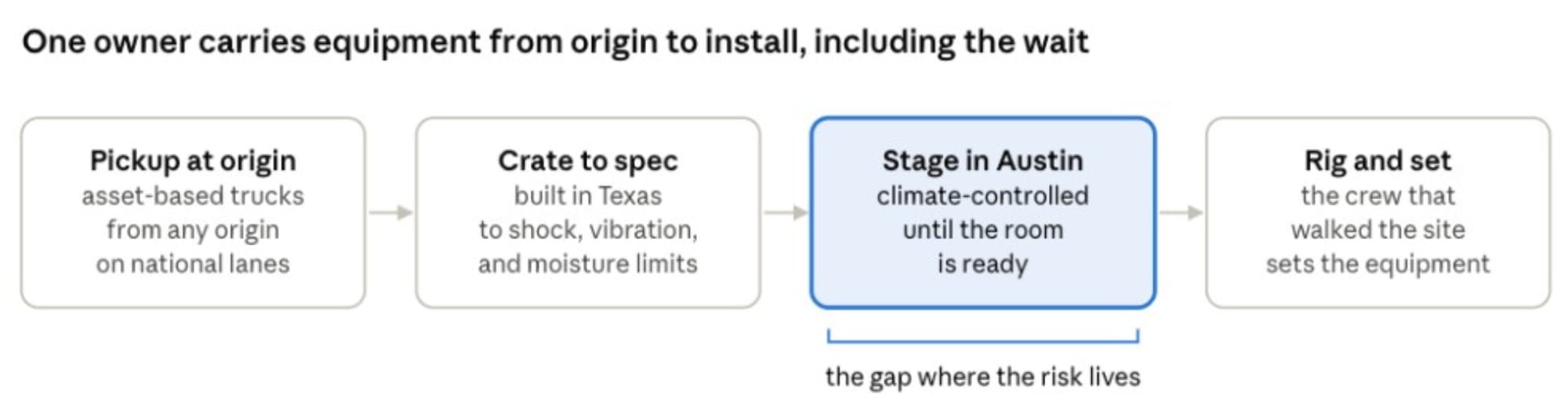
Same company the whole way: pickup, crating, staging, and rigging.
Climate-Controlled Warehousing in Austin Belongs on Your Critical Path
Climate-controlled warehousing just means storage that holds a set temperature and humidity range, with logs to prove it. Medical devices, lab instruments, and precision electronics often need exactly that, and Austin summers don’t care about specs.
This year Austin hit 100 degrees for the 27th time by August 24. Leave a crate in a trailer through that, and you could be recalibrating gear before install while your startup date slides. That’s a schedule problem wearing a storage costume.
The stakes are climbing for device makers too. Artivion recently bought its own Austin campus for its heart valve operations, and since February, FDA’s QMSR rules have let inspectors review supplier audit reports.
Our Austin warehouses are set up for it: conditioned space with temperature and humidity control for medical and biotech gear, SOPs written around your equipment, and an ISO 9001-certified quality system behind it.
Our advice? Ask any warehouse for its environmental records before you sign. Ours included.
Custom Crating in Texas, Built for the Worst Leg of the Trip
A good crate is the only protection that rides along the whole way: the truck, the warehouse, the dock, the hallway. It has to soak up shock, keep moisture out, and survive a lot of people who’ve never seen your equipment before.
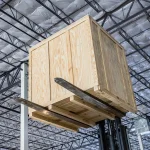
We build for the worst leg of the trip, and on a new facility job, the longest leg is often the wait. So the moisture barrier has to last weeks in storage as well as hours on the road. Our custom crating happens in-house in Texas, built to spec with heat-treated and stamped wood, anti-shock skids, and floating decks for anything that hates vibration.
If you’re coming from overseas, then the wood itself has rules. ISPM 15 requires crates to be treated, usually by heating the core to 56°C for 30 minutes, and stamped to prove it, per USDA APHIS. Basically a sauna for lumber. Skip it, and that microscope you can’t quickly replace sits at the port while your install date wanders off.
Why Machinery Movers in Austin Should Walk Your Site First
Say the crate clears the port in one piece. Now it has to get into your building. Every rigger I know has a story about a doorway that turned out narrower than the drawings. So the walk-through comes before your equipment ever leaves its origin:
- The whole path counts. Dock height, corridor widths, and floor loading from truck to install point get checked in person.
- It’s probably still a jobsite. Samsung reportedly weighed a temporary certificate of occupancy to run its Taylor fab before formal completion.
- Somebody has to own the ground. Under OSHA’s crane rules, certain rigging work needs a qualified rigger, and the GC usually owns ground conditions.
- Cleanrooms have dress codes. Learn the gowning rules on the walk-through before there’s a tool on the forks.
- The crew that walks it sets it. Our machinery movers in Austin open every rigging project with a preplan walk-through and an engineered lift plan, so nobody sees the stretch from tailgate to anchor bolts for the first time on move-in day.
Your Texas 3PL Should Own the Trucks Too
All of that assumes your equipment makes it to the tailgate in one piece. It’s probably coming from another state, maybe on whatever truck a broker could find, maybe through somebody’s cross-dock. If a crate shows up with its shock label gone red, everybody points at somebody else, and you’re stuck with the claim.
Meanwhile, ERCOT’s queue of big new power users hit 438 gigawatts in late May, and every data center in that line needs switchgear, UPSs, and PDUs hauled in. That’s a lot of switchgear looking for a ride.
Then there’s I-35, which nobody in Austin needs explained. TxDOT’s $4.6 billion rebuild reaches downtown in early 2027, so oversized loads need routes planned around it. Up north, our equipment movers in Dallas deal with their own orange barrels.
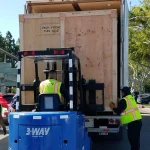
That’s why we run our own trucks, 48 states for our biggest accounts, and keep our own Texas 3PL warehouses in Austin and Dallas-Fort Worth for the wait. When it’s our truck, there’s nobody to point at but us. We like it that way.
One Partner, From the Truck to the Anchor Bolts
We’ve been doing this since 1954, and new sites still follow the same pattern: the building and the equipment keep different calendars, and the risk lives in the gap. We’d rather own that gap than hand it off.
So our trucks pick your equipment up, our Texas crew crates it for the trip it’s actually taking, our Austin warehouse keeps it in conditioned space until the room’s ready, and the crew that walked your site sets it. One semiconductor supply chain manager wrote that our crew secured a load “better than I have seen in 25 years.” In other words, regionally anchored and nationally capable.
You can start small too. Plenty of our longest relationships began with one move.
Bringing a new Austin or Texas facility online? Tell us what you’re moving and when the building should be ready. We’ll walk the site with you, take you through our Austin operation, and map out where everything waits. Call 408-748-3929 or drop us a line.
Frequently Asked Questions
Do 3PL Companies in Austin Also Move Machinery?
Some do, but plenty stop at storage and trucking. At Three Way, our asset-based Austin 3PL team runs the warehousing, the trucks, and the rigging in-house, so the same people stage your equipment, deliver it in phases as the building comes together, and set it in place.
Do Texas Machinery Movers Handle Cleanroom Moves?
The good ones do. Our Texas rigging crews follow cleanroom gowning and contamination-control procedures, then bring semiconductor tools, lab instruments, and medical equipment into the room and help your engineers with final placement.
How Long Can Equipment Be Staged Before Installation?
As long as your project needs. We offer short- and long-term storage in Austin and Dallas-Fort Worth, then release equipment to your site in phases that match construction progress, production timelines, or install milestones.
Do Oversize Equipment Loads Need a Permit in Texas?
Yes, if the load’s over Texas size or weight limits. The Texas DMV issues oversize/overweight permits through its TxPROS system, and some routes have bridge or clearance restrictions, so we plan the route before the truck rolls.
Does Three Way Have a Warehouse in Dallas?
We do. If you need a warehouse in Dallas for staging, our Dallas-Fort Worth team handles storage, crating, and cross-docking for machinery and servers, so North Texas projects can keep equipment close to the site.