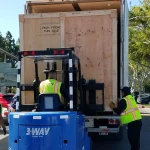

There’s a crate on your dock right now, big as a refrigerator, holding a rack worth more than every vehicle in your parking lot combined. The driver left an hour ago. Your receiving lead signed for it, but the install team doesn’t land until Tuesday.
Technically, that delivery went fine. The equipment arrived on time and in one piece. But now it’s sitting there, and it’s your problem.
White-glove server delivery exists to keep you out of that spot. Dock delivery ends at your loading dock. Inside delivery brings the crated equipment through your building to a staging spot. White glove carries the rack all the way to its position in the data room, uncrates it outside the hall, sets it with your engineers, and takes every piece of packaging back out the door.
A warning about the phrase itself, though. Every carrier in the country claims white glove. It’s been sitting on logistics homepages since about 2012, usually under a photo of a truck at sunset, and by now it means whatever the sales rep needs it to mean.
So skip the label and ask a sharper question: Where, exactly, does this equipment stop being the carrier’s responsibility and start being mine?
What Are the Three Delivery Tiers?
The names drift from carrier to carrier. The handoff point holds still, so that’s where we’ll draw the lines.
Dock Delivery: The Freight Stops at Your Building
The truck backs in, the crate comes off, somebody signs, the driver leaves. The last 40 yards between the roll-up door and the hall belong entirely to you.
We like dock deliveries, honestly, and they’re all that’s needed more often than not.it. They just assume your site has a dock at trailer height, a rated forklift, and a warehouse associate free at the delivery appointment.
And as an asset-based carrier, we can tell you which trailer’s coming and who’s driving it. Quite a better play than gambling on whatever the spot market had left that morning.
Inside Delivery: The Shipment Gets Past the Dock
A crew takes the crate off the trailer, walks it through your building to a spot you’ve chosen, and leaves it there still crated. Your data hall never sees them.
This is the tier for buildings that fight back: the site with no dock, the hall two floors up, the long stretch of polished concrete between the loading door and the freight elevator. When access is the whole problem, inside delivery solves it and stops there.
White-Glove Data Room Delivery: The Rack Lands On Its Tile
The crew finishes what the truck started. They uncrate in an approved staging area outside the hall, roll the rack to its row and tile with your engineers on the last 20 feet, and leave with every scrap of wood, foam, and banding on the truck. Done right, the only evidence anyone was there is a rack sitting exactly where the drawing said it would be. That’s the model we run for server racks, cooling units, and power equipment.
What Happens at Each Delivery Tier?
Same crate, three very different days. What those days look like is how the tiers earn their names.
What Happens on a Dock Delivery
Not much, and that’s the point. You set an appointment inside your receiving hours, the driver shows, the trailer opens, your forklift does the lifting, and somebody signs a delivery receipt.
The 30 seconds will feel silly right up until the day it doesn’t.
What Happens on an Inside Delivery
The real work happens a week before the truck moves, when somebody walks the route with a tape measure: door widths, threshold heights, the tight corner by the electrical room, what the freight elevator is rated to carry as opposed to what the building engineer remembers it carrying. Delivery day is skates, J-bars, floor protection, and a slow, careful push to the staging point, where the crew documents the crate’s condition before anyone touches a pry bar.
One caution before you promise anybody a date. Modern AI racks ship as a single sealed unit, wider and deeper than a standard 19-inch cabinet. Take a GB200 NVL72. It runs about 3,000 pounds; you can’t shave four inches off one to clear a doorframe, and with rack densities jumping from 16 kW to 27 kW in a single year, the crates aren’t getting any friendlier.
Our rigging division measures buildings before anybody books a truck, and our guide to moving heavy equipment shows what that survey looks for.
What Happens on a White-Glove Data Room Delivery
Days ahead of arrival, somebody sorts out badging and escorts, because no facility manager alive improvises access for four strangers with a pallet jack. On the day, the crew stages and uncrates outside the hall, walks the unit in, and sets it to the aisle plan while your people watch every foot of the move. Then the packaging leaves the way it came.
Our teams run two to four deep and come out of the same division that suits up in full cleanroom gear for semiconductor tool installs, so a live hall doesn’t rattle anybody. Our Dallas crews do this work every week, and there’s footage of them securing server crates if you’d rather see the standard than read about it.
When Is Each Delivery Tier Right?
Match the tier to your building, the bench you’ll have that day, and how much schedule you can afford to burn if a crate shows up wrong.
When Dock Delivery Is Right
If your own crew moves equipment for a living, take the dock and keep your money. Plenty of manufacturers have receiving teams who’ve forgotten more about material handling than most delivery crews ever learn, and paying outsiders to watch them work helps no one.
One question settles it: Who’s better positioned to move this unit through this building, your team or the carrier’s? Answer that honestly and the tier picks itself. The trouble we see comes from sites that never asked, where the dock team won by default.
When Inside Delivery Is Right
Access problems. That’s the whole answer. Sites without docks, projects that are still half construction zones, upper-floor halls behind a freight elevator, colos where your delivery window and your install window landed on different days.
It also carries staged deployments, where gear arrives early and waits in a build room or an offsite warehouse until the integration team wants it. Our warehousing across California, Oregon, Texas, and Arizona soaks up a lot of that lag. On projects running years ahead of move-in, somebody’s warehouse is doing that job. Whether it got planned or not.
When White-Glove Data Room Delivery Is Right
The rack has a go-live date, the hall is already running, or one clumsy handoff would cost more than the rest of the logistics budget combined. Any one of those is reason enough.
The market keeps shoving more deployments into that category. JLL has North American vacancy at 1% for the third straight year, while CBRE’s 2026 outlook and Data Center Frontier both describe delivery itself as the industry’s constraint now. Uptime Institute found 57% of major outages cost over $100K, and 1-in-5 clears $1M.
Capacity is spoken for years out, and the cost of fumbling at the finish line keeps climbing.
What Happens to the Crate? Removal, Reuse, and Cleanup
Whichever tier you pick, the crate outlives the delivery, and it’s the piece most scopes of work never mention. Strange, considering packaging manages to touch contamination protocol, fire code, freight claims, and state recycling law all at once. That’s a lot of exposure for a pile of wood.
- Uncrate Outside the Hall, No Exceptions: ASHRAE TC 9.9 holds data halls to ISO 14644-1 Class 8 cleanliness, and cardboard sheds particulate the entire time it sits there. DCD’s best practices will tell you the same thing your facility manager will, in nicer language.
- Photograph Everything Before the Pry Bar: Shoot the crate intact, then the contents, then the signed receipt.
- Grade Crates for Reuse Before Recycling: Purpose-built server crates survive shipping more often than people assume. Sorting the keepers and running them back to the manufacturer turns disposal into a return lane, which is what our crate management program does for a data center equipment maker today.
- Know Whose Packaging Rules You’re Under: California’s SB 54 regulations went permanent on May 1, 2026, per CalRecycle. Oregon’s program has been live since July 2025 and is still being argued in court, and this rundown tracks all seven states with packaging EPR laws on the books.
- Put the Debris Exit in the Scope of Work: Banding, foam, and pallet stock need a path out that keeps egress clear and flammables away from energized gear. It’s a five-minute conversation during planning and a two-hour argument next to an idling truck on delivery day.
Decide the Handoff Before You Book the Truck
Every choice above rolls up into one: Where does this equipment stop being someone else’s responsibility? Teams that name that spot early get the best kind of delivery day, which is the boring kind. Teams that don’t get the Friday crate.
We’ve been working that handoff since 1954. Three Way Logistics is asset-based, meaning the trailer at your dock is ours, with e-track in every one and climate control when the freight calls for it. Our data center group moves server racks, PDUs, UPSs, switchgear, and cooling equipment, and our crating shop built the box in the first place, so the crew that opens it answers to the same outfit that nailed it together.
We’ll also move you between tiers without making it a whole new project. Our Oregon operation runs dock delivery with crate removal at some sites and full data room white glove at others, for the same equipment manufacturer, on one process.
Deploying this year? Start with our data center relocation checklist, then come talk to us.