The check call didn’t die.
The logistics dashboard gave everyone a login, provided some visibility and gave both operations and logistics teams some comfort seeing a small truck icon inch across the screen.
But if you run logistics ops, you know that doesn’t give you complete visibility.
A single tracking dot doesn’t tell you whether that driver’s making the appointment, whether the reefer is truly holding the right temperature, or whether anyone with your logistics company is monitoring any potential slowdowns or issues.
And if there is an issue, a call and email directly to you can provide far quicker and accurate information than the portal. You need to know what’s going wrong, how bad it is, and what’s being done about it.
That’s a lot more important when U.S. business logistics is chewing through $2.4 trillion a year, about 7.8% of GDP, with volatility that’s apparently decided to move in permanently.
As an asset-based operation we see real-time logistics visibility up close and know where the software can be useful, and where it becomes a bottleneck.
What Is Real-Time Shipment Visibility Supposed to Tell You?
Real-time shipment visibility, done right, covers where the product is and what shape it’s in. But it also should advise what obstacles are coming up and what is being done to resolve them.
The location piece got solved ages ago. GPS, ELD feeds, and geofences are mature, cheap, and genuinely useful. The industry’s mistake was believing that a dashboard equals complete visibility. It’s a helpful indicator, but not a complete picture.
The stakes on the unsolved half keep climbing. SEMI has wafer fab equipment sales reaching $143.9 billion in 2026, up 23.1%. That puts more semiconductor tools and hyperscale power gear in transit than the industry has ever handled. All as dashboards are multiplying faster than the answers.
Why Do You Still Have to Call and Ask Where the Shipment Is?
Because the industry monetized the easy part and left the hard part TBD. A truck rolling between docks is the cheapest thing in the world to monitor, so that’s what got monitored. The waiting, the staging, the receiving mess, the parts of a shipment that generates issues, stayed your problem.
The research is blunt about where the pain lives. ATRI puts detention at nearly 40% of truckload stops, a $15 billion annual leak, all of it accumulating while freight sits and drivers fume.
Data center projects prove this on the receiving side. Early deliveries swamp staging space and late ones keep install crews waiting. Both get stamped on-time in the portal.
It’s the reason staging space can often be a visibility and tracking solution, and not just a real estate problem. It’s why we talk about operating depth over tech theater.
How Do Asset-Based 3PLs Provide Real-Time Freight Visibility?
Asset-based 3PLs provide real-time shipment visibility by owning the sources of the data. That means the trucks, the TMS on top of them, the warehouses, the WMS inside them, and the crews working all of it. One payroll, and, as your VP likes to say, one throat to choke. Your update doesn’t need to be requested or taken on faith, because the person reporting it is working directly with the team handling the product and equipment.
Brokered freight can’t offer that, structurally. Their visibility travels the same route as the blame, from a carrier, through a middleman, then to you. Escalation means asking someone to ask someone. Everyone potentially shading the truth a bit, even unintentionally.
Shippers have noticed. The latest 3PL study shows them demanding visibility and on-time delivery without having to chase either. Among providers, 61% take that pressure for visibility as an opportunity to turn relationships with their customers into strategic partnerships. When the survey shows shippers saying they want this “without having to chase it,” you can see where their current headaches are.
What Happens to Real-Time Shipment Visibility When Freight Changes Hands?
Chain of custody is the whole ballgame, and every handoff loosens the grip. Each additional party between you and your freight is another copy of the truth, slightly degraded, like a fax of a fax. Degraded truth on a load of pallets is annoying. On a crated lithography tool, it’s an 8D correction waiting to happen.
The loss data says thieves figured this out before the software vendors did. Verisk CargoNet counts cargo theft past $359 million in the first half of 2026, with an average stolen load around $341,518, concentrated in the exact states where high-tech manufacturing lives.
Fraud is the more insulting version, because the thief arrives holding paperwork. TIA found 97% of respondents naming truckload the most fraud-prone mode, with 22% eating six-month losses over $200,000 (Inbound Logistics). Those crews target the seams between parties, and a load with three middlemen is mostly seam.
What Should You Ask a 3PL About Real-Time Shipment Visibility?
Skip the feature tour for a minute and interrogate the org chart instead. You want to know who generates the location data, who’s watching the alerts, and what that person can authorize when something goes wrong. That tells you a lot more about real-time visibility than another polished dashboard demo ever will.
- Is the driver on your payroll or rented by the load?
- Who owns the alert before it becomes my problem?
- Walk us through the receiving side: door width, floor rating, dock plate, who meets the truck.
- Tell us about a move like ours that went sideways. The real story, not the brochure.
- When plans change, do we hear it from you, or from our receiving dock?
Question four usually tells you the most. Anybody can hand over a polished case study where everything went right. The better test is whether they’ll tell you about the ugly week, what failed, who owned it, and what they changed afterward. That kind of answer costs a little pride, which is exactly why it’s useful.
NMFTA now ties SCAC codes to verified humans, raising the floor for everybody. The strongest operators were already working that way.
How Does Three Way Logistics Handle Real-Time Shipment Visibility?
MHI Solutions’ leadership spent this year’s report arguing the edge goes to whoever operationalizes technology rather than whoever stockpiles it. We’ll cosign that. Our version of operationalization looks like this.
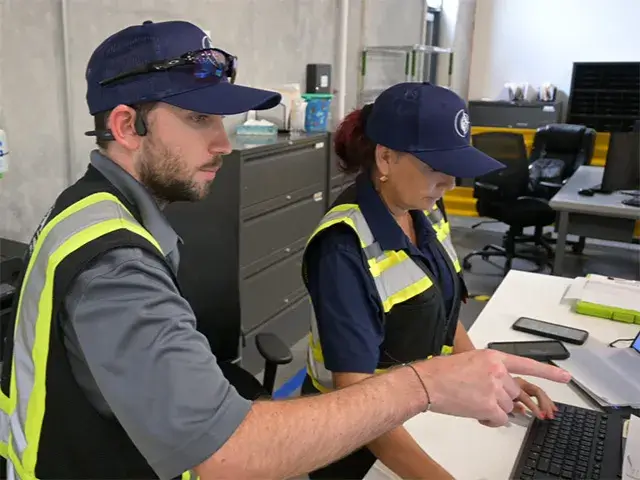
We run the systems, and you can check a shipment whenever the mood strikes. But our product has never been the screen. The product is that the dispatcher, the driver, the rigging crew, and the warehouse team handling your tool all draw a paycheck from the same company. An alert turns into action without a single external phone call.
One escalation path covers all four service lines, and your product never becomes one of these stories. Half of shippers in another recent 3PL study are consolidating vendors, and frankly, we get it.
The footprint backs it up: warehouses in California, Oregon, and Texas, our own trucks and specialized trailers across 48 states, a company at this since 1954. That’s 70 years of learning which mistakes are expensive and which are unforgivable.
If your team still keeps a carrier’s number taped to a monitor, you already know what the visibility subscription bought. Tell us about your shipment, and we’ll show you what an answer looks like.