
Hiring a server transportation company is easy right up until you ask how the job should actually work.
The pitch is usually polished. White-glove handling, real-time tracking, experienced crews, seamless execution. Fine. Now tell us who unloads the rack at 6:30 a.m., who checked the doorway, whether that crew works for you, and what happens if the cabinet arrives but the path to the data hall doesn’t cooperate.
That’s where the useful answers start.
We’ve spent more than 70 years moving equipment that gets expensive very quickly when somebody guesses. In data center logistics, the margin for improvisation is even smaller. A loaded AI rack can weigh about 3,000 pounds, and the power equipment behind the deployment may take years to replace.
Nobody wants to explain that a multimillion-dollar project slipped because the transportation plan was solid until the last 50 feet.
So don’t choose a provider based on how smooth the sales call sounds. Ask about the parts of the move that are easiest to gloss over and hardest to recover from.
These six questions will get you there.
Do You Own Your Trucks?
Ideally, yes. The fewer hands between you and the truck, the fewer places responsibility can get fuzzy.
That doesn’t mean a server transportation company has to own every tractor on every lane. We use partners too. What should bother you is finding out after the fact that the company you hired quietly handed your racks to somebody else.
So ask early: Who will physically haul this load, and whose MC and DOT numbers will be on the truck?
If it’s the provider’s equipment, the answer should take about 10 seconds. If it’s a partner carrier, you should hear who they are, how long they’ve been used, and why they’re trusted with this kind of freight.
That distinction carries more weight after the Supreme Court’s 9-0 Montgomery v. Caribe Transport decision, which opened brokers to negligent-hiring claims over carrier selection.
At Three Way, we’ll tell you which moves run on our own equipment and which don’t. You deserve to know who has the keys before your racks leave the dock.
Who Handles Racks Between Pickup and Delivery?
As few people as possible.
The cleanest move is one driver, one trailer, and a seal that stays intact from pickup to delivery.
Every transfer adds another chance for something to go wrong, and thieves know exactly what’s worth stealing. Cargo theft reached about $725 million across the U.S. and Canada last year, while recent reports have called out server blades and fiber optic transceivers by name.
The uglier part is how ordinary some thefts look. Deceptive pickups, where someone arrives with forged paperwork or a stolen carrier identity, rose 31% in Q1, with roughly half occurring in California.
So ask exactly who touches the load and how each handoff is verified. At Three Way, that means matching IDs, dispatch records, and carrier information before the doors open.
No matter how hard a server transportation company tries, “We’ve never had a problem” isn’t a security process.
Have You Moved Loaded Server Racks Before?
A good answer should come with details, not a confident “yes.”
Ask what kind of racks they’ve moved, what went wrong on past jobs, and what they check before they commit to a price. An experienced server transportation company will start talking about your building pretty quickly: dock height, door clearances, floor loading, tight turns, cooling connections, and where the rack actually has to land.
After all, an NVL72-class rack weighs roughly 1.36 metric tons in a compact footprint. You don’t move one the same way you move a few pallets of servers.
The same goes for equipment. Air ride is always required, and depending on the site, the job may call for a Conestoga trailer, climate control, or a rigging crew for the final placement.
If the answer stays vague, press harder. Loaded racks have a way of exposing people who learned the job from ChatGPT.
What Happens in the Last 100 Feet?
This is where the rack leaves the transportation plan and meets the building.
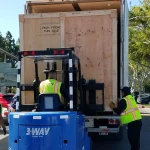
A strong server transportation company should be able to walk you through that stretch before move day: who unloads the rack, who uncrates it, how the path was checked, what equipment is coming inside, who sets the rack, and what happens if reality doesn’t match the drawing.
Because reality has a sense of humor. The doorway is two inches tighter than expected. A turn won’t clear. Somebody skipped a step because the crew was running behind. Uptime Institute found that 1-in-5 operators said their last major outage cost more than $1 million, with skipped procedures still a leading cause of human-error outages.
Ask to see the procedure in writing, including names, stop-work rules, and responsibility for crating and removal.
We’ve won large campus operations from 15-year incumbents because customers cared about management depth and execution once the truck arrived. The last 100 feet tends to reveal both.
Where Will My Racks Wait If the Site Isn’t Ready?
Somewhere close, secure, and preferably under the control of the same server transportation company handling the move.
That sounds obvious until the construction schedule slips. Data centers can go up in under 18 months while medium-voltage switchgear remains sold out into 2028 in some channels, so racks don’t always arrive on the same timeline as the room they’re supposed to enter.
When that happens, you don’t want to hear, “We’ll find somewhere to put them.” You want an address.
The right warehouse should be close enough to the site that a revised install date doesn’t turn into another long-haul move. You should also know who’s receiving the racks, who’s photographing them, and who’s calling if a crate shows up damaged.
That’s why we’ve built operations around the places our customers are deploying equipment, including Austin and the Bay Area. If the site isn’t ready, your racks still need a plan.
How Will You Document Each Rack From Pickup Through Delivery?
You should get enough documentation to trace every rack without having to reconstruct the move from emails and phone calls.
A serious server transportation company should record each rack by serial number, photograph it at pickup and delivery, and document every exception on the bill of lading. “We moved 500 drives” proves a job happened but proves nothing about what happened to yours.
If decommissioning is part of the project, ask which version of NIST 800-88 they follow. Revision 2 replaced Rev. 1 in September 2025, so an answer built around the old standard tells you plenty about how current their process really is.
The same traceability belongs on a live move. Each rack should be tied to the slot it left, the slot it reached, and the condition it arrived in, ideally through a proper WMS.
Our data center relocation checklist shows what that paper trail should look like before the first rack moves.
What Should You Know Before You Hand Over the Racks?
After six questions, you should be able to picture the move before a truck ever backs into the dock.
You should know whose equipment is showing up, whether your rack stays on that trailer, where it goes if the site slips, who gets it through the building, and what record you’ll have when the job is finished. If any of those answers are still fuzzy, the quote probably isn’t the thing you should be worrying about yet.
That’s also a pretty fair description of how we run Three Way.
We’ve been doing this since 1954, and over time we’ve brought transportation, warehousing, crating, rigging, and final placement into the same operation because passing expensive equipment from company to company creates problems nobody needs. Our semiconductor and data center work has only made that more obvious.
Got racks coming? Give us the count, the site, and the delivery window. We’ll walk through the move with you and tell you where we see trouble before the trouble has a chance to introduce itself.